Pekka Toppi

Rescued a gridlocked project and consolidated 10+ BBC login systems into a single account

BBC · Interaction designer · Shipped and still in production
Problem
A long-running project with a bad internal reputation, gridlocked by stakeholder politics. Ten-plus membership systems, each with an owner who didn't want to give it up.
My contribution
Lead interaction and visual design, end to end. Co-planned and co-ran the research. Ran the stakeholder unlock.
What changed
Every system owner committed. A stalled project shipped — and is still in production at BBC. Members participate across BBC Online with one account instead of ten.

Role: Interaction designer, working alongside a senior designer who mentored me. Alongside the membership work, contributed designs and guidelines for pan-BBC design patterns and main website elements.

Scope: 10+ membership systems consolidated into one. Pan-BBC reach. Strict public-service accessibility mandate. Core team: product owner, project manager, 4 engineers, plus BBC's in-house usability research team.

Duration: Around seven months, ending at launch. Shipped, and still in production.

Starting condition: Politically stalled. Poor internal reputation. Trust already spent.

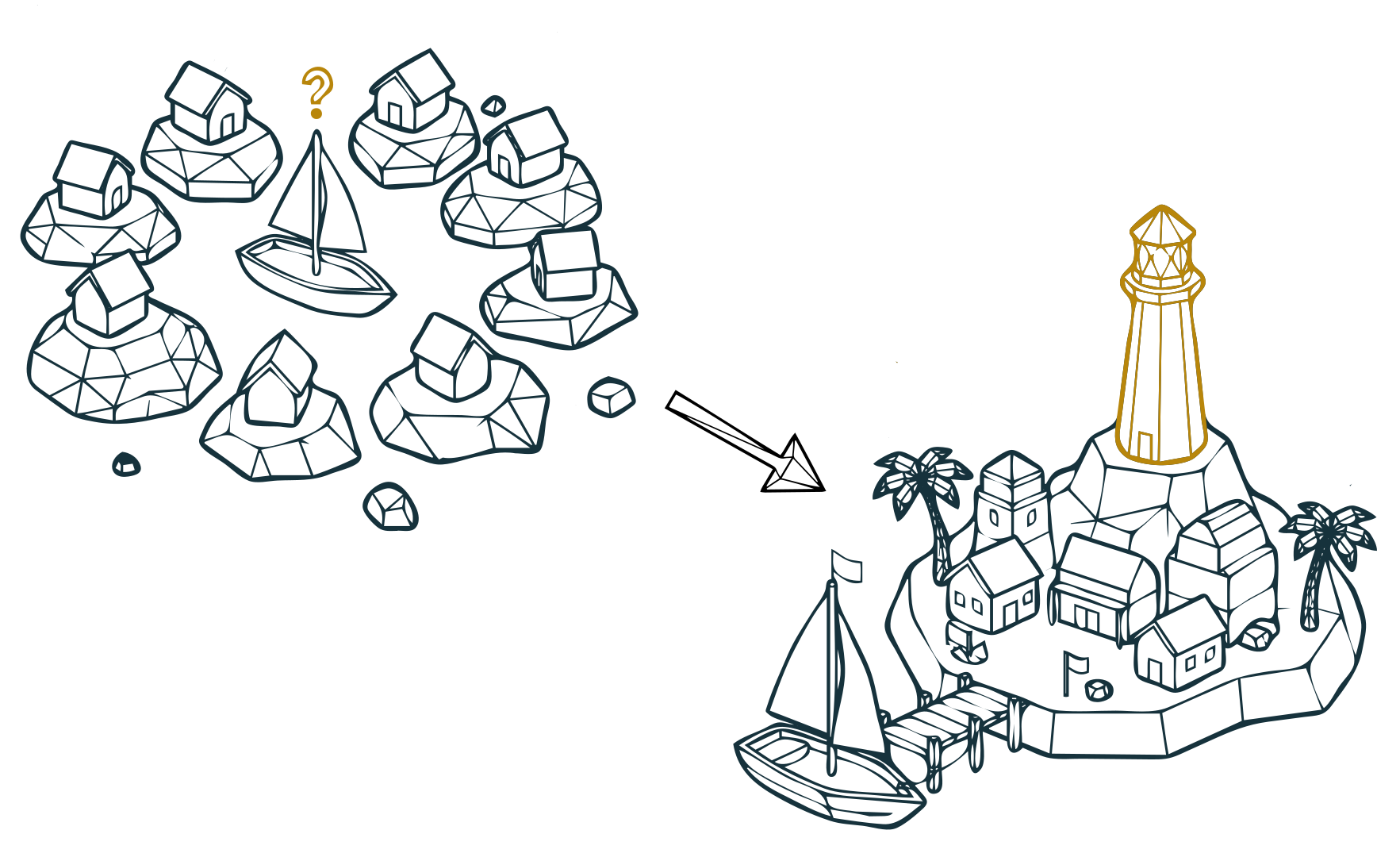
Diagram — "Consolidation map", 16:9
Ten-plus separate systems, each with an owner holding veto power, collapsing into one account.

The bet

BBC Online ran more than ten membership systems across its product areas. A member following football on Sport and a show on CBBC needed separate logins. Behind the scenes, maintaining the sprawl drained engineering resources.

The bet was easy to state and hard to land: one account for all of BBC Online — if the owners of the existing systems could be persuaded to retire them. That persuasion had already failed once.

The project wasn't behind because it was technically hard. It was behind because nobody trusted it.

Success, defined up front: members participate across BBC Online with a single account; legacy systems can be switched off; sign-up completion holds; accessibility bar met or raised.

1 · Influence without authority

Constraint
Each membership-network owner feared a unified system wouldn't serve their audience. The project's poor standing gave them every reason to keep resisting. I had no authority over any of them.
Decision
No central mandate. One-on-one workshops, one owner at a time, surfacing each group's real concerns and then showing visibly how the design absorbed them.
Trade-off accepted
Slow, political, and front-loaded. Weeks before a pixel moved.
Outcome
Every owner committed. A project close to standstill could move again.

2 · Progressive profiling

Constraint
BBC wanted richer member data. Members guard their privacy. Different areas legitimately needed different information. The tension could have sunk sign-up entirely.
Decision
Ask the bare minimum at registration; defer everything else to in-context moments where the value is obvious.
Evidence
Several information-gating versions tested with BBC's usability team, five to seven participants each.
Finding
Members will complete profiles later, if the request is explained clearly and doesn't interrupt flow.
Trade-off accepted
Gave up upfront data capture. Got people finishing registration.

The progressive-disclosure pattern established here was reused across member-facing areas rather than solved once per product — consistent with the wider pan-BBC pattern work I contributed to on the core design team.

3 · Killing visible CAPTCHAs

Constraint
Visible CAPTCHA was the anti-abuse default. It's also a wall for anyone using assistive technology — and BBC's accessibility mandate is not negotiable.
Decision
Remove visible CAPTCHAs entirely; solve abuse another way.
Reasoning
Internal and public accessibility research.
Trade-off accepted
Spent political capital arguing down an industry default. Leadership agreed.

4 · Embedding in the dev team

Constraint
Multiple prior designer handovers had stalled development and blurred expectations.
Decision
Stop designing at arm's length. Join the engineering team, attend daily scrums, track all design inside their agile board.
Outcome
Design and build moved in lockstep. Shipped on schedule.

What changed

Stakeholders changed position — from actively blocking to committed. The clearest delta in the project.

Members changed behaviour — testing showed people who abandoned long sign-up forms would complete their profiles later when asked in context. That finding changed the design.

BBC changed its estate — a fragmented set of logins replaced by one account across BBC Online.

It lasted. Still in production at BBC — a durability most redesigns never reach.

What I'd do differently

I knew in principle that participatory design reduces resistance to change. What I hadn't experienced was the scale of the effect when you make it the central activity rather than a supporting one.

Bringing the system owners into the design didn't move the project incrementally. It unlocked it.

At this kind of scale, design leadership is mostly the diplomacy around the design — and participation is the most powerful instrument available for it.

I'm open to head, lead, and staff product design roles.